
Jobs Abroad for Freshers: The Honest 2026 Guide for Indian Graduates
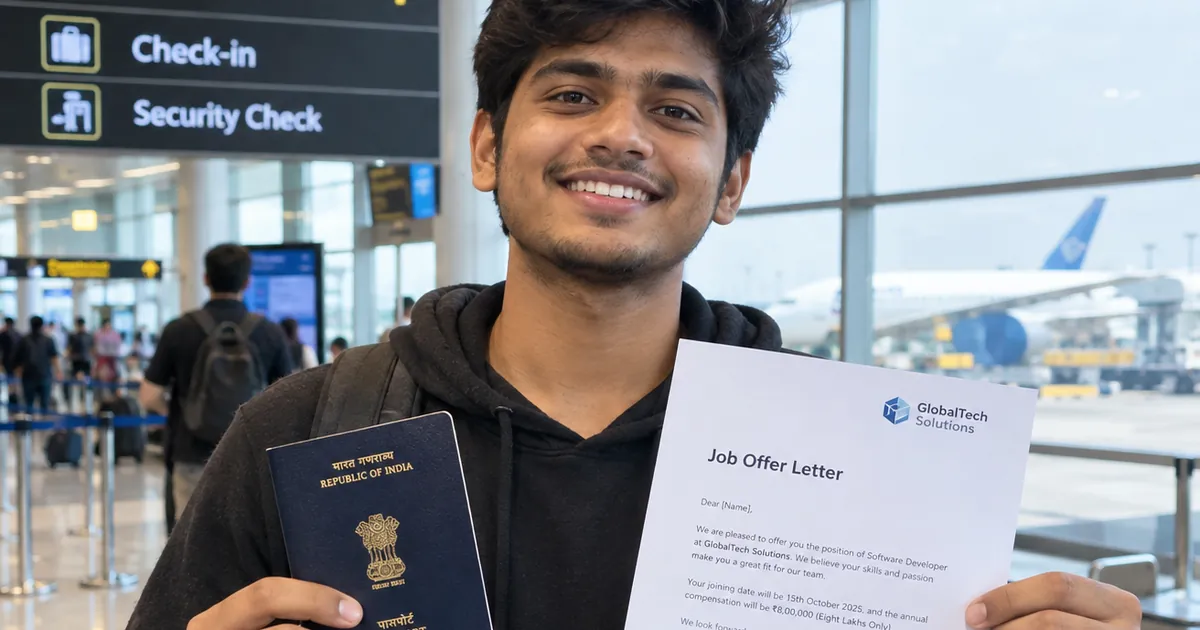
Every week someone walks into our Chennai office with the same folder under their arm: degree certificate, passport, a CV printed that morning, and one question. "Sir, I just finished college. Can I really get a job abroad, or is that only for people with five years' experience?"
You can. We have watched plenty of freshers do it. But the path looks different from what most job portals show you. Scrolling through hundreds of "abroad vacancy" listings is the slowest way in. The faster way is to pick a country that has a door built for young graduates, prepare the exact papers that door asks for, and apply only through channels you can verify.
This guide walks you through that, one step at a time. We have kept it specific to Indian freshers, so you will find the visa schemes open to Indian passport holders, the eMigrate rules nobody explains properly, and the warning signs of fake agents we see far too often.
Can an Indian Fresher Really Get a Job Abroad?
Yes, and the reason is simple. Several countries now run visa programmes aimed at people in their twenties who have a degree and not much else yet. These schemes exist because those countries want young workers, and India signed mobility agreements with them to open the door for Indian graduates specifically.
What stops most freshers is not a lack of openings. It is applying in the wrong way. A fresher who sends the same CV to 200 overseas listings on a job portal usually hears nothing back, because most of those roles need a work visa the employer does not want to sponsor for someone without experience. A fresher who first secures a visa that lets them work, and then applies, is in a completely different position. The employer no longer has to take a risk on sponsorship.
So the question to ask is not "which company will hire me from India?" It is "which visa can I get on my own, and which employers in that country hire people like me?"
Best Countries for Jobs Abroad for Freshers
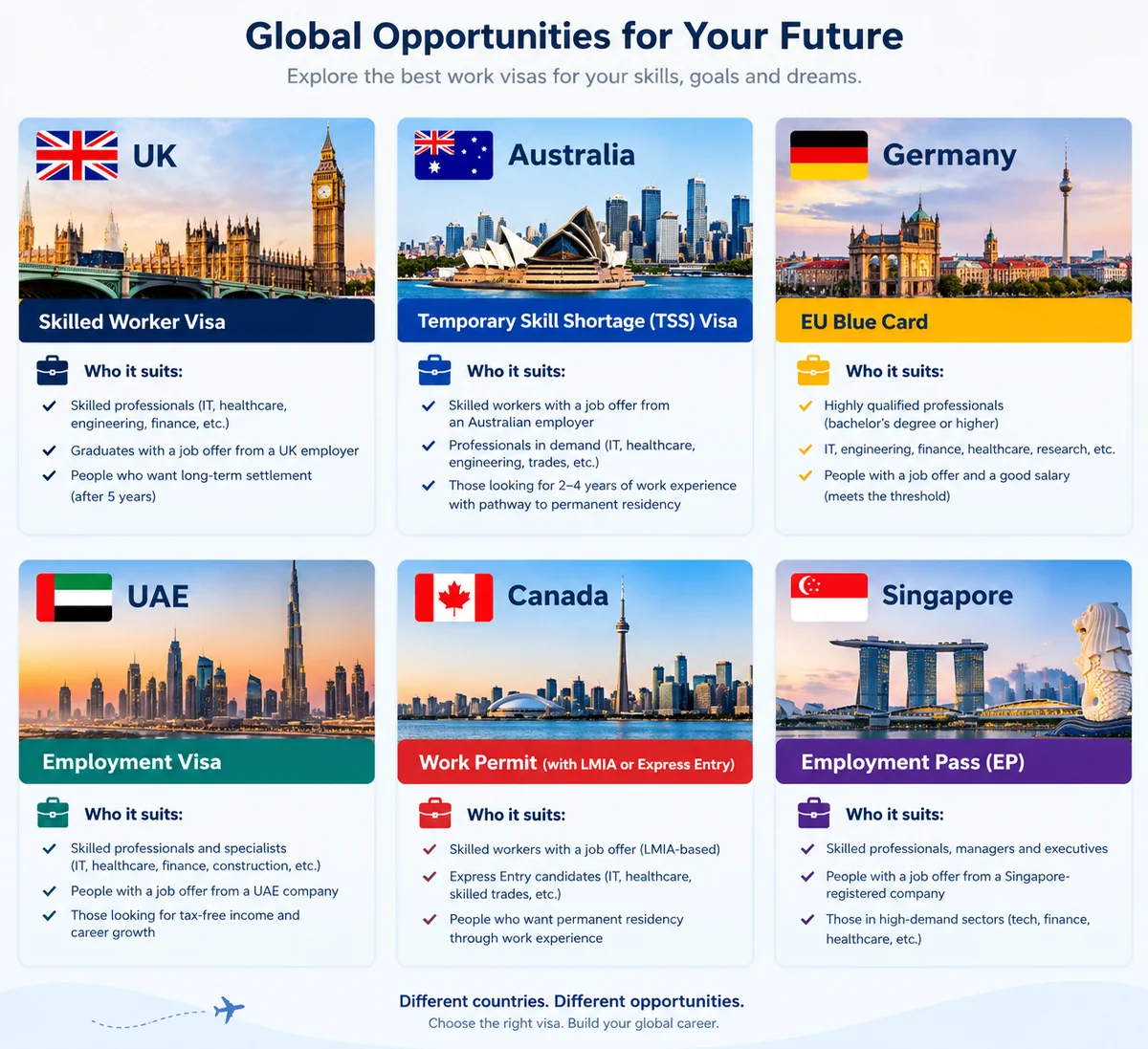
Here are the routes we recommend most often to Indian graduates. Rules change every year, so treat the table as a starting point and confirm details on the official government page before you apply.
| Country | Route for freshers | Who it suits | Check before applying |
|---|---|---|---|
| United Kingdom | India Young Professionals Scheme | Graduates aged 18–30 with a bachelor's degree or higher | Ballot dates, savings requirement, up to 2 years' stay |
| Australia | MATES (subclass 403) | Recent graduates, 30 or under, from eligible Indian institutions in fields like engineering, ICT, AI, FinTech, AgriTech, mining and renewable energy | Graduation within the last 2 years, English score, ballot |
| Germany | Opportunity Card (Chancenkarte) | Graduates willing to learn German and job-hunt on the ground | Points or recognised degree, proof of funds, German or English level |
| UAE and Gulf | Employer-sponsored work visa | Freshers in hospitality, retail, sales, healthcare support, engineering and accounts | Written contract, eMigrate clearance if your passport is ECR |
| Canada | Study-to-work, or employer-sponsored roles | Mostly freshers who first study in Canada | Direct fresher hiring from India is rare, so plan a study route |
| Singapore | Employment Pass or S Pass | Strong IT, engineering and finance graduates | Salary thresholds make fresher hiring selective |
United Kingdom: the India Young Professionals Scheme
The UK sets aside 3,000 places a year for Indian citizens aged 18 to 30 who hold at least a bachelor's degree. You do not need a job offer to apply. Places are given through a free online ballot, usually held in February and July, and if you are picked you can live and work in the UK for up to two years in almost any job. You will need to show savings, so check the current amount on gov.uk before you enter. For a fresher, this is one of the few ways to reach the UK job market without an employer sponsoring you.
Australia: the MATES scheme
MATES stands for Mobility Arrangement for Talented Early-professionals Scheme. It is open to Indian graduates who finished their degree within the last two years at an eligible institution and who studied in one of the listed fields, such as engineering, ICT, artificial intelligence, FinTech, AgriTech, mining or renewable energy. You apply through a ballot, and successful applicants can work in Australia for up to two years without a sponsoring employer. If you are a recent B.E. or B.Tech graduate, look at this one first.
Germany: the Opportunity Card
Germany's Opportunity Card lets you enter the country for up to a year to look for work, and you can take part-time jobs while you search. You qualify either with a degree Germany recognises in full, or by scoring enough points for education, language skills, age and links to Germany. You must show you can support yourself while job-hunting. Basic German makes a huge difference here. Freshers who arrive with A2 or B1 German find jobs much faster than those relying only on English.
UAE and the Gulf countries
For many freshers, especially from Tamil Nadu and Kerala, the Gulf is the quickest place to start earning. Employers in Dubai, Abu Dhabi, Qatar and Saudi Arabia hire freshers in hotels, retail, sales, facilities, nursing support and junior engineering roles. The employer arranges the work visa. Your job is to make sure the offer is real and the contract is in writing, which we cover in the scam section below.
Canada and Singapore
We are honest with students about these two. Direct jobs in Canada for freshers applying from India are rare, and most Indians who work there started with a study programme. Singapore does hire Indian graduates, but its work passes have salary thresholds that favour candidates with strong skills or a few years' experience. Both are worth planning for. Neither is usually the first stop.
Foreign Jobs for Freshers: Which Fields Are Hiring
Some degrees travel well. If yours is on this list, your chances of landing jobs overseas for freshers go up noticeably.
- Nursing and allied health. Nurses are in demand in the UK, the Gulf, Germany and Australia. Each country has its own registration exam, so start that process early.
- Engineering. Civil, mechanical, electrical and chemical graduates find junior and site roles in the Gulf, and the MATES scheme is open to engineering graduates.
- IT and software. Entry-level developer, QA and support roles. Your GitHub profile and project work matter more than your marks.
- Hospitality and tourism. Hotel management graduates get hired in the Gulf, the Maldives and on cruise lines.
- Accounts and finance. Junior accountant and audit assistant roles, especially in the UAE. A certification such as ACCA helps a lot.
- Teaching. English teaching jobs abroad in parts of Asia and the Middle East, usually needing a TEFL or TESOL certificate.
Arts and commerce graduates without a specialist skill can still go, most often through the UK Young Professionals Scheme or retail and customer service roles in the Gulf. A short course in a specific skill such as accounting software, digital marketing or a language will make your CV much easier to shortlist.
How to Get a Job Abroad from India, Step by Step
This is the process we walk freshers through at CareerGateway. It works whether you are applying on your own or with help.
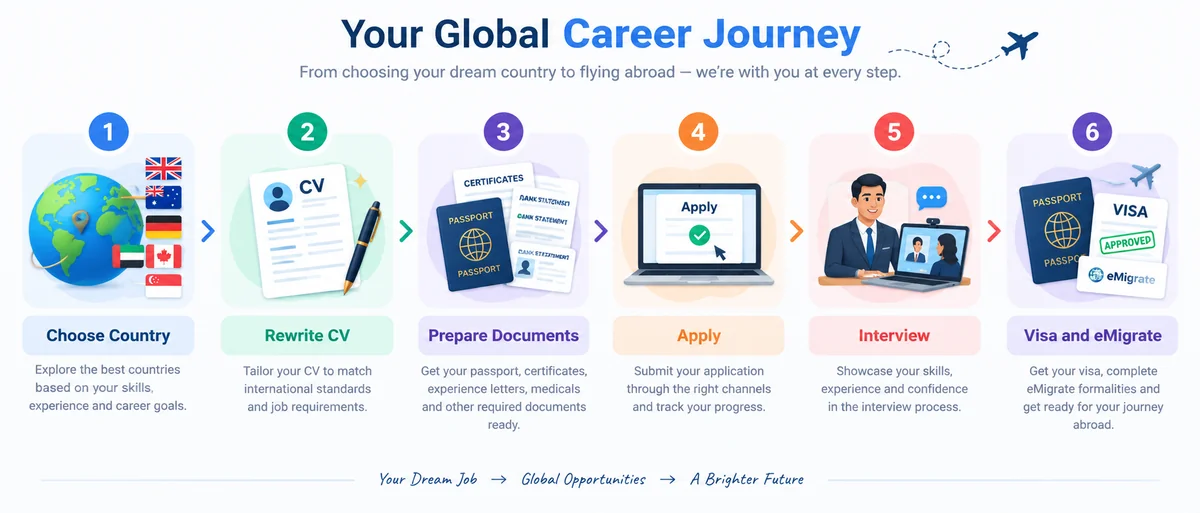
Step 1: Pick one country and one visa route
Freshers who apply everywhere at once usually end up nowhere. Choose one country based on your degree, your age, your budget and whether you are willing to learn a language. Then find the visa route you personally qualify for. Write it down. Every step after this depends on that choice.
Step 2: Rewrite your CV for that country
An Indian-style CV with a photo, date of birth, father's name and a "declaration" at the bottom will look odd to a UK or Australian recruiter. They expect one to two pages with no personal details beyond contact information. German employers often do expect a photo. Gulf employers often ask for passport details. Match the format to the country. As a fresher, put your projects, internships and certifications near the top, because that is your experience.
Step 3: Get your documents ready
- Passport valid for at least a year, ideally longer.
- Degree certificates and mark sheets, attested or apostilled depending on the country. Gulf countries usually want attestation, including by that country's embassy. Countries in the Hague Convention accept an MEA apostille.
- Language test score such as IELTS or PTE for the UK and Australia, or a Goethe certificate for Germany, if your route asks for one.
- Police clearance certificate from Passport Seva, which many work visas require.
- Medical test, which Gulf countries require at approved centres.
Attestation alone can take a few weeks, so start this while you are still applying, not after you get an offer.
Step 4: Apply through channels you can trust
Use company career pages, the official job portals of your target country, LinkedIn with your location set to that country, and recruiting agents registered with India's Ministry of External Affairs. Portals like Naukri and Indeed do list abroad job vacancies for freshers, but check every listing's employer independently before you share documents.
Step 5: Clear the interview and read the offer carefully
Most first-round interviews for jobs abroad happen on video. Test your camera and internet the day before, and prepare to explain why you want to work in that country specifically. When the offer comes, read it line by line. Look for the monthly salary, working hours, accommodation, the contract length, and who pays for your visa and flight. If any of these are missing, ask for them in writing.
Step 6: Apply for the work visa and emigration clearance
Your employer or the scheme will tell you which visa to apply for. If you are going to a Gulf country or Malaysia, you may also need emigration clearance from the Indian government through eMigrate. The next section explains who needs it.
ECR, ECNR and eMigrate in Plain Words
This is the part most blogs about jobs outside India skip, and it is the part that stops people at the airport.
Indian passports are either ECR (Emigration Check Required) or ECNR (Emigration Check Not Required). If you have passed Class 10 or higher, your passport is normally ECNR. Most graduates are ECNR, which means you do not need emigration clearance.
If your passport is ECR and you are travelling for work to any of the 18 notified countries, you need emigration clearance from the Protector of Emigrants through the eMigrate portal. Those countries are Afghanistan, Bahrain, Indonesia, Iraq, Jordan, Kuwait, Lebanon, Libya, Malaysia, Oman, Qatar, Saudi Arabia, South Sudan, Sudan, Syria, Thailand, the UAE and Yemen.
How to Spot a Fake Overseas Job Offer
Every year Indian embassies warn about fake recruiters, and we meet families who have lost lakhs to them. Freshers are targeted most, because they are eager and have not seen a real offer before. Walk away if you see any of these.

- They ask for money before any interview has happened.
- The offer letter arrives only on WhatsApp, from a Gmail or Yahoo address, with no company website you can check.
- You are told to travel on a visit or tourist visa and "convert it" to a work visa later. This is illegal in most countries and leaves you with no protection.
- The agent's licence number does not appear in the list of registered recruiting agents on emigrate.gov.in.
- The fee is above ₹30,000 plus GST. That is the legal ceiling a registered recruiting agent can charge a worker, and they must give you a receipt.
- The salary is far higher than anything else you can find for the same role in that country.
- They pressure you to decide within a day or two.
Before paying anyone, look up the agent's registration on eMigrate, search the company on the official business registry of that country, and call the company's listed office number yourself. A real employer will not mind.
What It Costs to Move Abroad as a Fresher
Costs vary so much by country that any single number would mislead you. Here is what to budget for, so nothing surprises you.
| Expense | Who usually pays | Notes |
|---|---|---|
| Visa fee | You for UK YPS, MATES and Opportunity Card; often the employer for Gulf jobs | Check the fee on the official visa page |
| Health surcharge or insurance | You | The UK charges an Immigration Health Surcharge upfront |
| Language test | You | IELTS, PTE or Goethe exam fees |
| Document attestation or apostille | You | Plan a few weeks for this |
| Flight | Often the employer for Gulf jobs; you for most other routes | Ask for it in writing |
| Proof of funds or savings | You | Required by the UK YPS and Germany's Opportunity Card |
| First 1–2 months of living costs | You | Rent deposit, food and transport before your first salary |
A Gulf job with employer-paid visa and flight costs the least to start. The UK and Germany routes need more money upfront, but they give you freedom to change jobs once you are there.
Do You Need an Abroad Placement Consultancy?
You do not have to use one. Plenty of freshers apply on their own, especially for ballot schemes like the UK YPS and MATES, which are free to enter online.
A good abroad placement consultancy earns its fee when things get complicated: when you need your CV rebuilt for a new country, your documents attested correctly the first time, an interview rehearsed, or an employer's offer checked before you sign. What you should never pay for is a "guaranteed job". No honest consultant can promise that, because the employer makes the final call.
When you compare consultancies, ask three plain questions. Are you registered with the MEA as a recruiting agent, or are you a training and guidance service? What exactly do I get for the fee? Can I speak to someone you placed last year?

Not sure which route fits you?
Our team in Chennai, with a global office in Australia, helps freshers choose a country, rebuild their CV for it, and prepare for interviews and visa paperwork. Bring your degree and your questions, and we will tell you honestly which door is open to you.
Frequently Asked Questions
Can an Indian fresher get a job abroad?
Yes. The easiest routes are visas designed for young graduates, such as the UK India Young Professionals Scheme, Australia's MATES scheme and Germany's Opportunity Card, along with entry-level hiring in the UAE and other Gulf countries.
Which country is best for a fresher job?
It depends on your degree. Engineering and IT graduates under 30 should look at MATES and the UK Young Professionals Scheme. Graduates willing to learn German should look at the Opportunity Card. Freshers who want to start earning quickly often begin in the UAE.
Can I get a job abroad without experience?
Yes, but you need something that stands in for experience: internships, a strong final-year project, a recognised certification or a language score. Employers abroad hire freshers when they can see proof of skill on paper.
How do I apply for jobs abroad from India?
Choose one country and visa route, rewrite your CV in that country's format, prepare attested documents, and apply through company career pages, official job portals, LinkedIn or an MEA-registered recruiting agent.
How much can a recruiting agent legally charge?
A recruiting agent registered with the Ministry of External Affairs cannot charge a worker more than ₹30,000 plus GST, and must issue a receipt.
What is ECR and do I need eMigrate clearance?
ECR means Emigration Check Required. If your passport is ECR and you are going for work to one of 18 notified countries, including the UAE, Saudi Arabia, Qatar, Kuwait, Oman, Bahrain and Malaysia, you need clearance through eMigrate. Most graduates hold ECNR passports and do not.
How do I know if an overseas job offer is fake?
Be wary if you are asked for money before an interview, if the offer comes only on WhatsApp, if you are told to travel on a visit visa, or if the agent's licence is not listed on emigrate.gov.in.

Written by Bharath Raj
CareerGateway Team · Researcher and Expert in Overseas Job Consulting
Bharath researches visa routes, employer demand and emigration rules for Indian job seekers, and works with freshers at CareerGateway to plan their first move abroad. He holds a B.E. in Chemical Engineering from Coimbatore Institute of Technology.
Visa rules, fees and ballot dates change often. Always confirm the latest details on the official government website of the country you are applying to, and on emigrate.gov.in for Indian emigration rules.